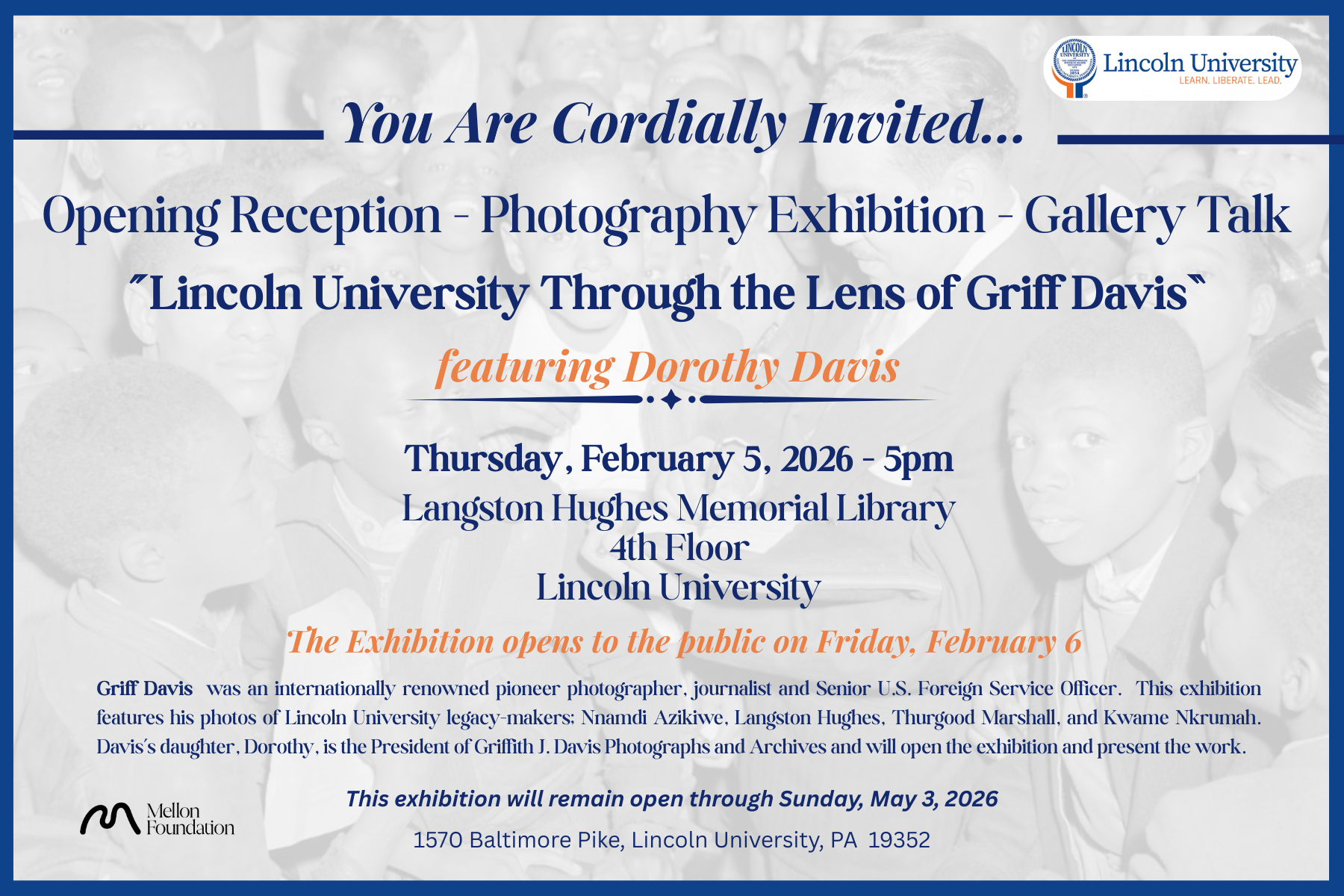
LINCOLN UNIVERSITY, PA – January 22, 2026 – On February 6th, Lincoln University will open Lincoln University through the Lens of Griff Davis, an exhibition that depicts the early movements of four globally recognized alumni and luminaries of Lincoln University — Harlem Renaissance writer and author of “The Weary Blues” Langston Hughes ‘29; the first African-American U.S. Supreme Court Justice Thurgood Marshall ‘30; Ghana’s first President Kwame Nkrumah ‘39, who launched the independence and pan-African movements in Africa that have become the global diaspora movement of today; and the first President of Nigeria Nnamdi Azikiwe ‘30 and ‘32, respectively. They’re returning to campus decades after their graduation through an exhibition of photographs by Griff Davis that capture their ascendance to becoming icons.
The collection will open in recognition of the Centennial of Black History Month and Langston Hughes’ birthday, February 1st, at the Langston Hughes Memorial Library, Special Collections and Archives, which has served as a centerpiece for Lincoln University students since the institution's founding in 1854. The library is honored to host this exhibition showcasing the life and work of Griff Davis, whose contributions exemplify the Lincoln story through connections to such extraordinary leaders and thinkers.
The staff of Special Collections and Archives including Archivist, Raquel Lightner, Archivist Assistant, Ashley Gillard, and Graduate Assistant, Lori Danley, scoured the Lincoln University archival collections and focused on selecting materials that spoke to the work of these men as Lincoln University students. This exhibition includes personal letters and ephemera from these men that represents their time at Lincoln University and highlights their intimate connection to Lincoln University and the surrounding community.
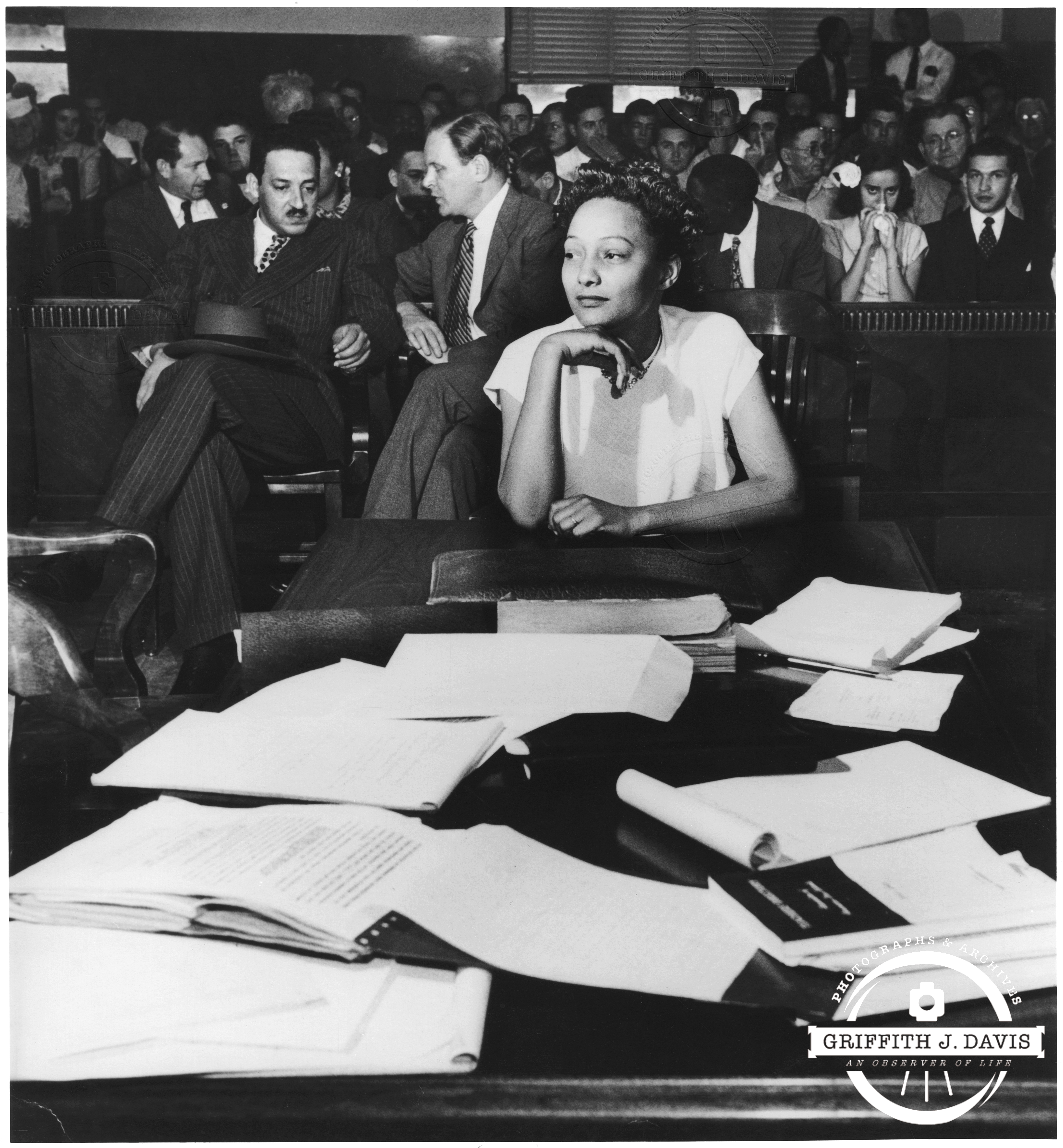 “The minute I stepped on Lincoln‘s campus in preparation for this exhibition,” said Dorothy M. Davis, daughter of Griff Davis and Founder and President of Griffith J. Davis Photographs and Archives, “I instantly felt like I had come to the trunk of the tree that prepared and sprouted each one to carve new mindsets. The mission of Griffith J. Davis Photographs and Archives is to encourage people to take the road less traveled as did my dad alongside these four luminaries.”
Griff Davis’ career simultaneously documented and interpreted the U.S. Civil Rights Movement and the Independence Movement in Africa to each other. Born in Atlanta, Georgia, Davis attended Morehouse College before being interrupted by World War II. Upon his return to campus, he became a student in Langston Hughes' "Creative Writing” class at Atlanta University (now Clark Atlanta University). At the recommendations of Langston Hughes, he became EBONY Magazine’s first Roving Editor and, subsequently, became the only African American student in the Class of 1949 of Columbia University Graduate School of Journalism. While attending Columbia, he rented a room in Langston Hughes’ Harlem home. Davis worked in many capacities in the foreign service for USAID from 1952 to 1985. He was an Advisor to the Bureau for Africa, the Bureau for Population and Humanitarian Assistance, and African governments Liberia, Tunisia, and Nigeria. He also repeatedly traveled to over 25 of Africa's then 51 countries and several European countries during his career. Griff Davis died in 1993, leaving an explosion of untold stories to be shared with generations to come.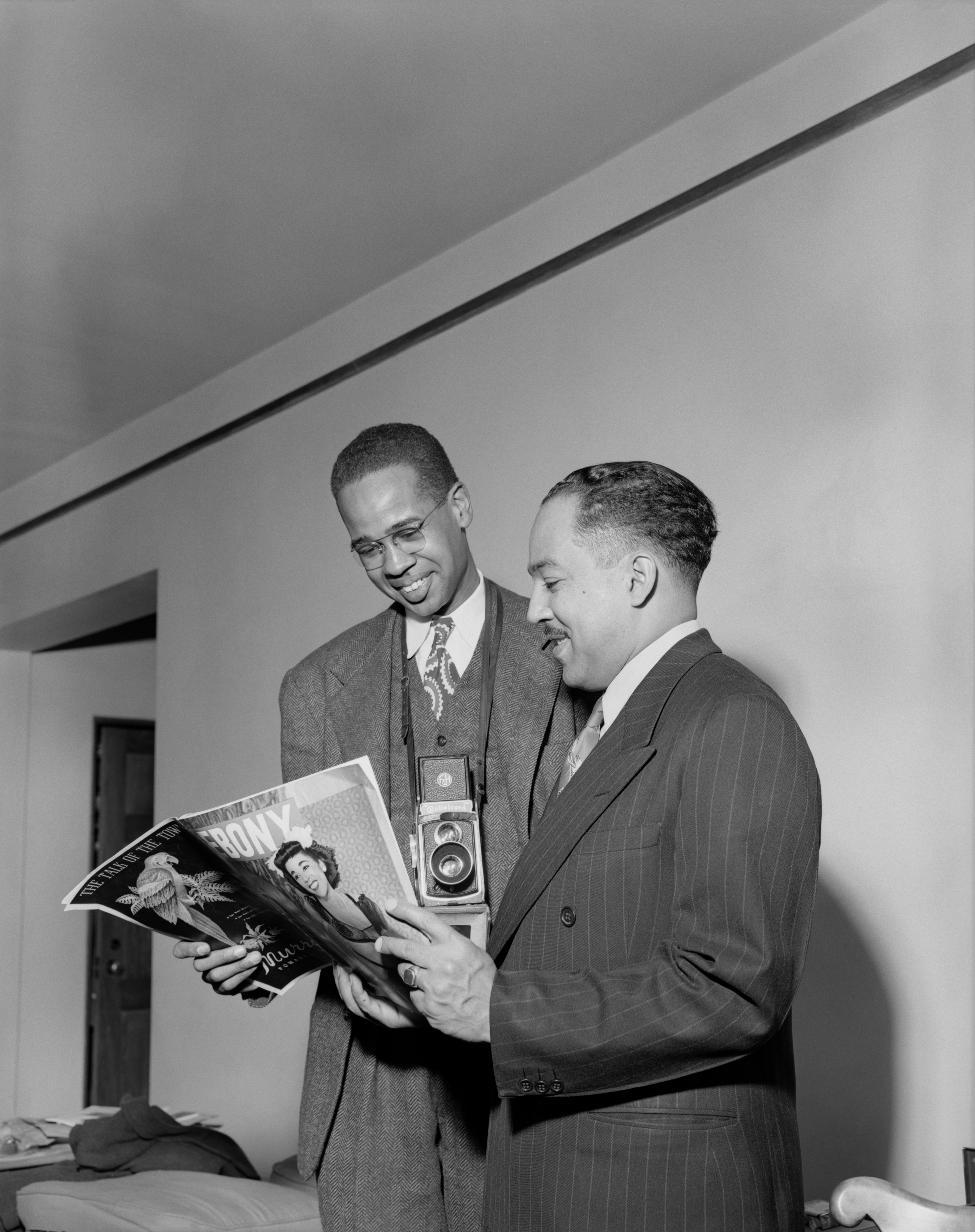
The exhibit, curated by Dorothy Davis, tells an intimate story of intertwining legacies and generational impact that travels from the Americas to Africa, across the Diaspora. The collection, consisting of photographs and letters, captures the personal bonds Hughes, Azikiwe, Nkrumah, and Marshall built aside from their public personas at the university and thereafter. In Langston Hughes’ May 29, 1954 letter to Davis, he wrote “I’ve just had two letters from Azikiwe who’s headed this way next week, so I’ll see him either here or at Lincoln’s Centennial Commencement where he is to speak. Nkrumah wrote me a nice letter, too, not long ago."
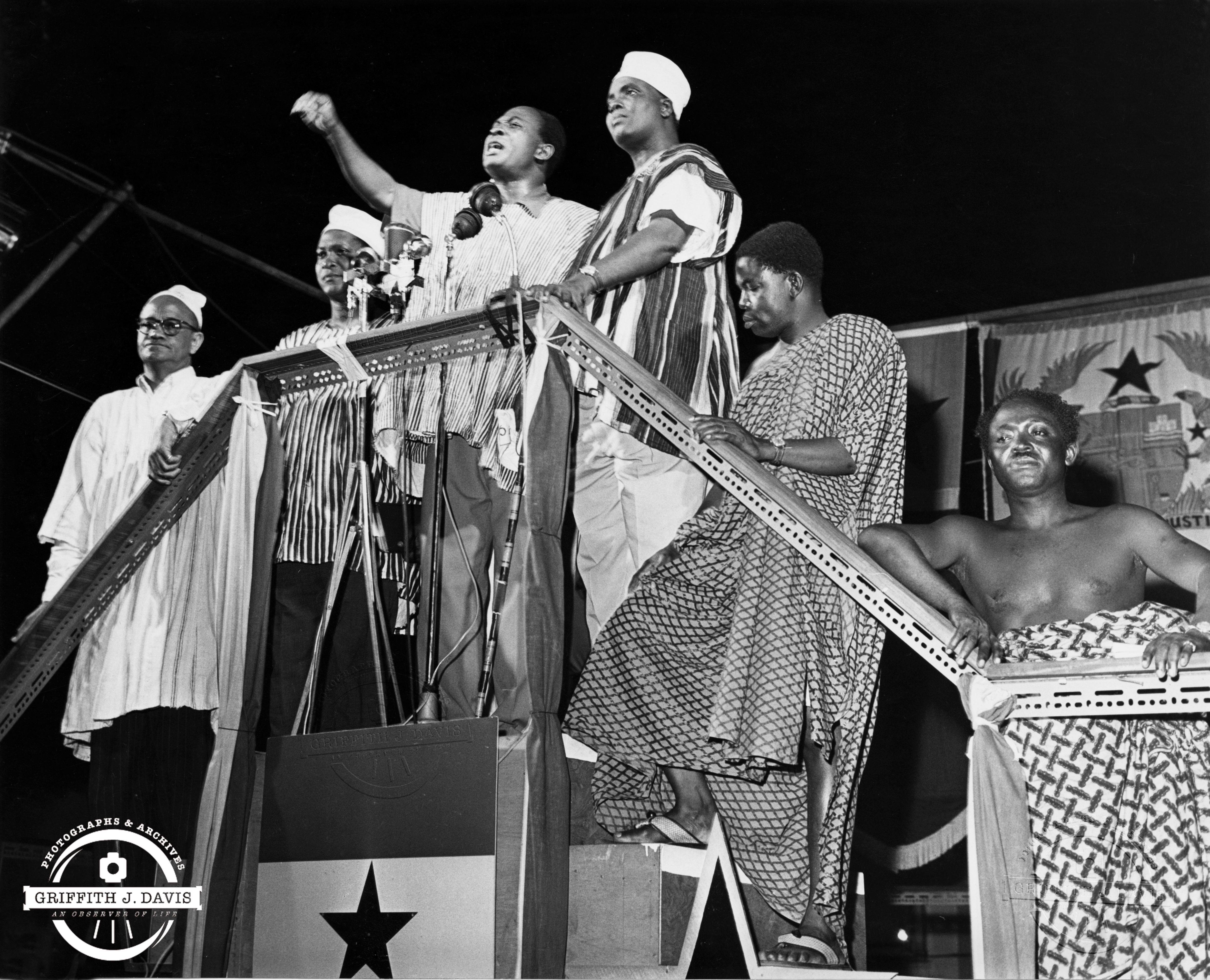
The African Union recognizes the global diaspora as being its sixth region. A statue of Kwame Nkrumah stands at the front of the entrance to the African Union in Addis Ababa, Ethiopia honoring his vision for African unity and independence. “The growing momentum of the global African Diaspora made the United Nations General Assembly extend the First International Decade for People of African Descent into the current Second International Decade for People of African Descent from 2025 to 2034,” said Ms. Davis. “The theme of the Decade is recognition, justice and development -- the same core principles of these four Lincoln University alumni.”
In the times of Jim Crow, civil unrest, and the pursuit of African independence, Lincoln University through the Lens of Griff Davis, echoes the pride, force and humanity five educated Black men embodied as they supported each other to overcome the systems not designed for their communities all while reflecting the commitment to freedom we continue to acknowledge today. 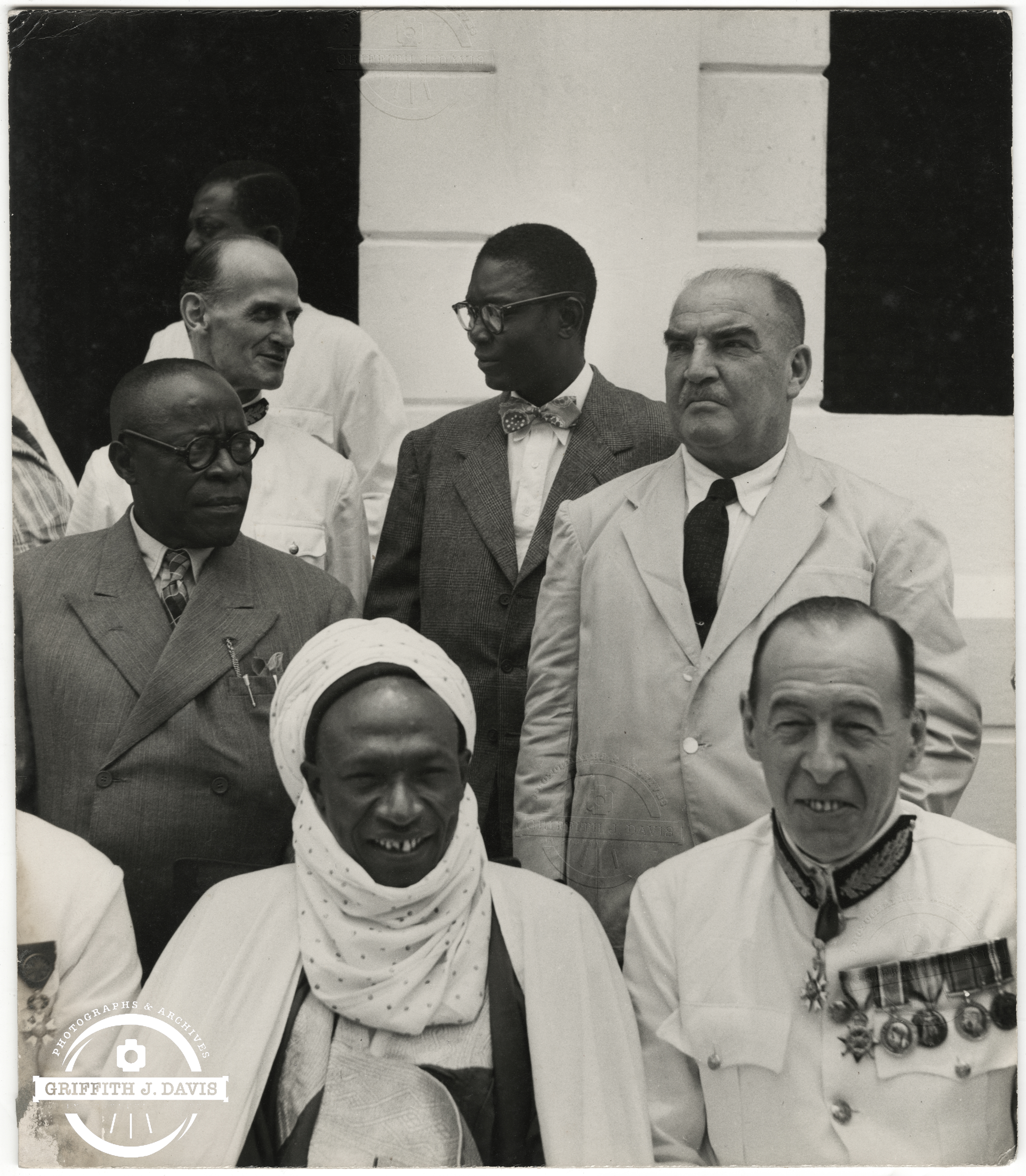
"We are pleased to be able to honor Lincoln University’s legacy by hosting this exhibition, Lincoln University through the Lens of Griff Davis,” says Dr. Mahpiua Deas, Provost & Dean of Faculty at Lincoln University. “Griff Davis reminds us of the power of a liberal arts education to nurture the critical thinking necessary to foster meaningful societal change and to offer solutions to injustice. We hope our students are inspired by this exhibit and consider how they, too, can make meaningful contributions through their academic disciplines.
Lincoln University through the Lens of Griff Davis will be open to the public starting Friday, February 6th at the Langston Hughes Memorial Library on Lincoln University’s main campus during Special Collections and Archives hours, Monday-Friday from 8:00am- 4:30pm. The exhibition will remain open until Sunday, May 3rd.
###
About Lincoln University
Lincoln University, the nation’s first degree-granting Historically Black College and University (HBCU), educates and empowers students to lead their communities and change the world. Lincoln offers a rigorous liberal arts education to a diverse student body of approximately 1,650 men and women in more than 34 undergraduate and graduate programs. To learn more about Lincoln University, visit www.lincoln.edu.
About The Griffith J. Davis Photographs and Archives
The Griffith J. Davis Photographs and Archives is dedicated to unearthing, illuminating, and shaping global narratives rediscovered through the photographs and archives of Griff Davis. By providing context for the present, its goal is to inspire future generations to take the road less traveled through exhibitions, lectures, and film. To learn more about The Griffith J. Davis Photographs and Archives, visit https://www.griffdavis.com/.
Media Contact
Athena Griffith-Howard
Associate Vice President, Communications & Marketing E-mail: agriffithhoward@lincoln.edu
Office of Communications
Phone: 484-365-7427
E-mail: communications@lincoln.edu
1570 Baltimore Pike
Azikiwe-Nkrumah Hall Rm. 105
Lincoln University, PA 19352
